Why Your Water Heater Is Leaking at the Bottom
A puddle under your tank rarely fixes itself. Here are the real reasons water heaters leak at the bottom in Pahrump, what repair costs in 2026, and when to replace.
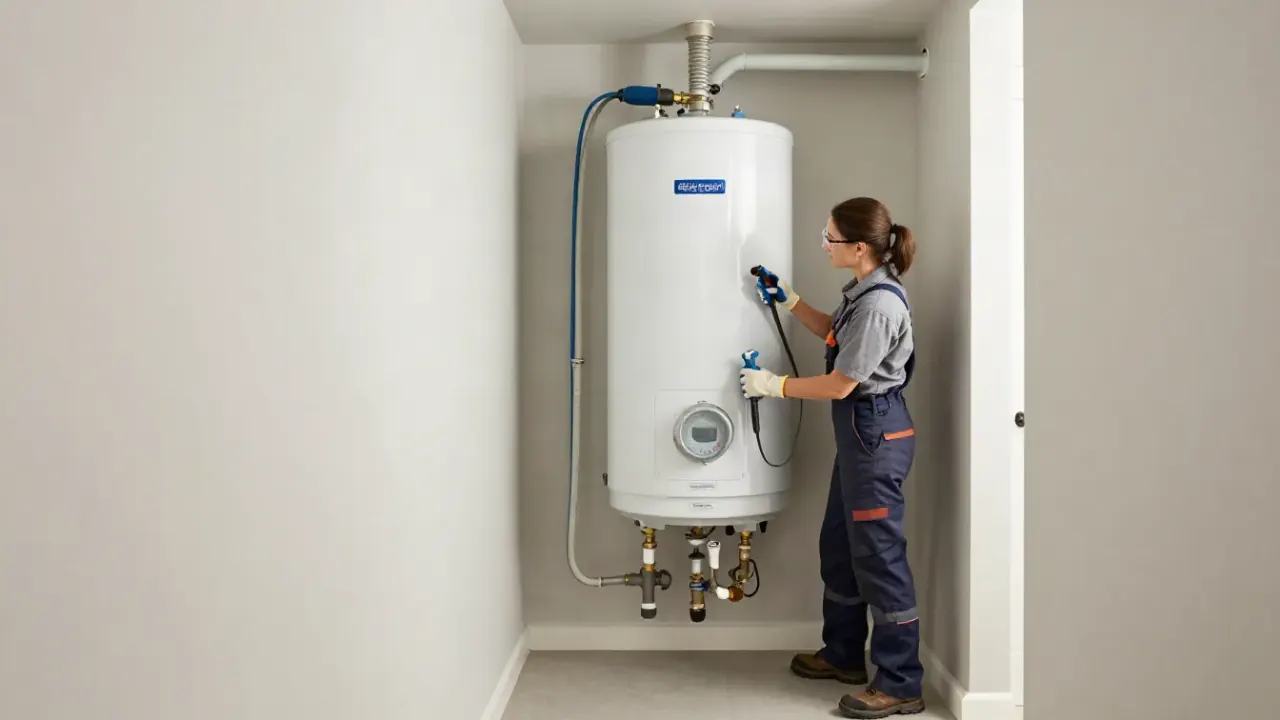
Water at the base of your tank almost always means one of two things: a loose fitting or drain valve is dripping from above and running down, or the steel tank itself has rusted through and is failing. If the water is coming through the shell, no repair will stop it - the tank is done and needs replacement. If it is coming from a fitting, we can usually fix it the same day.
That distinction matters more than anything else in this article, because it is the difference between a $150 repair and a $1,400 replacement. Below, we break down every cause we run into across Pahrump, how to tell them apart in about five minutes, what 2026 pricing looks like here, and when it is time to stop patching and start planning.
The Short Answer: Where the Water Is Actually Coming From
A water heater leaking at the bottom in Pahrump NV is a symptom, not a diagnosis. Water always runs downhill, so a drip from the T&P valve, the inlet nipple, or a supply line connection can land at the base of the tank and look exactly like a tank failure.
Before you assume the worst, dry the tank completely with a towel, wait 20 minutes, and watch where the first bead of water appears. Water that reappears high on the tank or on a pipe is a fitting problem. Water that seeps through the metal shell itself, usually near a seam or the drain valve collar, is a tank problem.
Here is the quick breakdown:
- Fitting or valve leak: repairable, usually $150-$400 in parts and labor.
- Tank shell leak: not repairable, replacement required, $1,200-$2,400 installed.
- Condensation (tankless or high-efficiency units): not a leak at all, no repair needed.
If you want a second opinion before you spend anything, our team handles Water Heater Leak Repair Pahrump NV and can usually tell you which category you are in within minutes of arriving.
Why Is My Water Heater Leaking at the Bottom in Pahrump NV?
Water heaters in Pahrump leak at the bottom for six main reasons, and the local water is a factor in at least three of them. Pahrump sits on hard, mineral-heavy groundwater, and whether your home is on a private well or the community system, that calcium and magnesium load does not disappear at the meter.
Hard water does two things to a tank. First, it accelerates scale buildup on the bottom of the tank and around the drain valve, which stresses the metal. Second, it eats anode rods faster than the national average. A magnesium anode rod that lasts five years in a soft-water city often lasts three here. Once the anode is gone, the tank steel becomes the sacrificial metal, and rust-through follows.
Our desert climate adds a second pressure. Summer attic and garage temperatures push 120°F and higher, and thermal expansion cycles the tank harder than a mild climate would. Every heat-up and cool-down flexes the tank shell and the fittings on top of it.
If you have owned your home for years and never had the tank serviced, the odds are good that the anode is spent and the tank is on borrowed time. We handle Anode Rod Replacement & Tank Flushing Pahrump NV for exactly this reason - it is the cheapest way to add years to a tank that is still sound.
What Causes Water Heater Bottom Leaks in Pahrump Nevada
Pahrump water heater leak causes fall into two buckets: leaks from parts you can replace, and leaks from the tank itself. Here is what each one looks like in the field.
1. A failing drain valve
The drain valve sits at the bottom of the tank, and it is the single most common source of a bottom puddle. Sediment collects around the valve seat, the plastic or brass body cracks, and water weeps out slowly. You will usually see a mineral crust or white chalky ring around the valve stem. This is a repair, not a replacement - we swap the valve, flush the tank, and you are back in business.
2. A loose or corroded T&P valve
The temperature and pressure relief valve is on the side or top of the tank, but when it drips, the water runs down the shell and pools at the bottom. A T&P valve that drips constantly usually means one of two things: the water is too hot (above 210°F) or the system pressure is too high (above 150 psi). Both need attention - a dripping T&P is a safety signal, not just a nuisance.
3. Loose inlet and outlet connections
The cold-in and hot-out nipples on top of the tank use dielectric unions and gaskets. Over time, heat cycling loosens them. A quarter-turn with a wrench often stops the drip, but if the threads are corroded, the nipple needs replacing.
4. A cracked tank weld or seam
This is the one that ends a water heater's life. Tanks are welded steel with a glass lining. When the lining cracks and the anode is depleted, rust works through the weld seam. You will see a rust streak running down the side of the tank, and the water will keep coming back no matter how many times you dry it. No sealant, epoxy, or patch holds on a pressurized tank - anyone who tells you otherwise is selling you a temporary fix that will fail within weeks.
5. Sediment-driven overheating
In hard-water areas, a layer of scale builds up on the bottom of the tank, trapping water underneath it. The burner or element heats the sediment instead of the water, the tank bottom gets hotter than designed, and the steel fatigues. You will hear popping or rumbling sounds before you see the leak. That noise is the sound of a tank cooking itself.
6. Condensation on a tankless or heat-pump unit
If you have a tankless or heat pump water heater, water at the base is often condensation from the combustion or heat-exchange process, not a leak. Tankless units in Pahrump can produce a surprising amount of condensate in the summer when incoming water is warm and the unit is working hard. If the water is clear, odorless, and appears only during operation, it is likely condensate draining from the unit. If it appears when the unit is off, it is a leak.
We see this most often in the newer builds around Mountain Falls water heater repair calls, where heat pump and tankless installs are common and homeowners are not used to seeing condensate lines drip.
How to Tell a Tank Leak From a Fitting Leak
You can diagnose this yourself in about five minutes with a dry towel and a flashlight. Here is the process we walk homeowners through on the phone.
- Shut off the gas or power. For gas, turn the dial to the off position. For electric, flip the breaker. Do not skip this.
- Shut off the cold-water supply at the valve on top of the tank.
- Dry the entire tank - top, sides, and base - with a towel.
- Wait 20 minutes and check again with a flashlight, starting at the top and working down.
- Trace the water upward. If the first wet spot is on a pipe, valve, or nipple, the leak is above. If the first wet spot is on the tank shell itself, the tank is failing.
One more tell: a tank shell leak usually leaves a rust-colored stain or a trail of mineral deposits running down the side. A fitting leak usually leaves a clean drip with a chalky white ring at the source. If you see rust on the tank body itself, plan for replacement, not repair.
If you are not comfortable doing this yourself, that is fine. We run water heater leak detection Pahrump NV calls every week and can confirm the source in minutes.
Can a Water Heater Leaking at the Bottom Be Fixed?
Yes, if the leak is coming from a replaceable part - a drain valve, T&P valve, nipple, or supply line. No, if the tank shell itself is leaking. That is the whole answer, and it is worth repeating because it saves people money.
Here is how we decide, and how you should too:
- Repairable: drain valve, T&P valve, inlet/outlet nipples, supply line connections, heating element gaskets, and thermostat-related drips.
- Not repairable: rust through the tank shell, cracks at the weld seam, leaks at the base of the tank where the shell meets the bottom head, and any leak that returns after a proper repair.
If your tank is under 8 years old and the leak is from a fitting, repair is almost always the right call. If the tank is 10 to 15 years old and the shell is leaking, replacement is the only honest answer. A tank that has rusted through once will rust through again, and the next leak may be a flood rather than a puddle.
For tanks that are still sound but aging, we often recommend a flush and anode service to buy time. For tanks that are done, we handle Water Heater Replacement Pahrump NV and can usually install the same day or next day.
Water Heater Bottom Leak Repair Cost in Pahrump Nevada
Typical 2026 pricing in this area runs $150 to $400 for a fitting or valve repair, and $1,200 to $2,400 for a full replacement, depending on tank size, fuel type, and whether any code upgrades are needed.
Here is what drives the number:
- Drain valve replacement: $150-$300, including a tank flush.
- T&P valve replacement: $180-$350, including a pressure check.
- Anode rod replacement and flush: $200-$450, depending on tank height and access.
- Supply line or nipple repair: $150-$300.
- 50-gallon gas replacement, installed: $1,400-$2,200.
- 50-gallon electric replacement, installed: $1,200-$1,900.
- Tankless replacement: $2,000-$3,500, plus descaling if the unit has never been serviced.
Two things push cost up in Pahrump specifically. First, attic and garage installs in the summer are hot, slow work, and access matters. Second, if your old unit was installed without an expansion tank or a proper pan and drain line, current code may require adding them. That is usually $150 to $400 in parts and labor.
We quote the job before we start, and the number we say is the number you pay. No diagnostic fee on the first visit for leak calls.
Common Mistakes We See Homeowners Make
The most expensive mistake is trying to seal a tank shell leak with epoxy, JB Weld, or silicone. It never holds. A water heater tank runs at 40 to 80 psi and cycles through 100°F temperature swings daily. Any patch on a pressurized, expanding steel shell will fail, usually within a few weeks, and often while you are away from home.
The second mistake is ignoring the first drip. A slow drain valve leak costs $150 to fix today. Left alone for a year, it rusts the tank bottom from the outside in, and now you are looking at a $1,500 replacement instead. Water and steel do not negotiate.
The third mistake is turning the temperature up to compensate for a tank that is not keeping up. If your hot water runs out faster than it used to, the problem is usually sediment or a failing lower element, not the thermostat setting. Crank the dial to 140°F and you accelerate scale, risk scalding, and stress the T&P valve. We see this constantly on no hot water troubleshooting Pahrump calls - the tank was fine, the element was not.
The fourth mistake is skipping the anode rod. It is a $30 part that protects a $1,500 tank. In Pahrump's hard water, we recommend checking it every three years and replacing it every four to five.
When to Call a Professional
Call us when the water is coming through the tank shell, when you smell gas, when the breaker trips every time the tank runs, or when you simply cannot tell where the leak is starting. Those four situations cover 90% of the calls we run.
Also call if the tank is over 10 years old and leaking, if the leak returns after you have tightened everything you can reach, or if you see standing water more than a quarter-inch deep around the base. Water that deep means the leak has been running a while, and the floor, drywall, or subfloor around the unit may already be damaged.
At Pahrump Water Heater Repair, we find the leak, tell you honestly whether it is a repair or a replacement, and do the work the same visit whenever parts allow. If you are in Central Pahrump water heater repair territory or anywhere else in the valley, we can usually be there the same day.
Frequently Asked Questions
Why is my water heater leaking at the bottom in Pahrump NV?
Either a fitting above the tank is dripping and running down, or the tank shell has rusted through. Dry the tank, wait 20 minutes, and trace the first wet spot upward. Water on a pipe or valve is a repair; water seeping through the steel shell means replacement.
Can a water heater leaking at the bottom be fixed in Pahrump?
Yes, if the leak is from the drain valve, T&P valve, nipples, or supply lines - typically $150 to $400. No, if the tank shell itself is leaking. A pressurized steel tank cannot be patched, and any sealant fix fails within weeks.
What causes water heater bottom leaks in Pahrump Nevada?
Hard water is the leading cause. It eats anode rods in three to five years instead of five to eight, builds sediment that overheats the tank bottom, and corrodes drain valves. Add desert heat cycling and most tanks here fail earlier than the national average.
Should I replace a leaking water heater in Pahrump?
Replace it if the tank shell is leaking, if the unit is over 10 years old, or if a repair has already failed once. A 50-gallon replacement installed in Pahrump runs $1,200 to $2,400 in 2026, and we can usually do it same or next day.
How long can I wait before fixing a bottom leak?
Days, not months. A slow drain valve drip can rust through the tank bottom within a year, and a shell leak can go from a puddle to a flood without warning. Shut off the water and power now, then call.
Get Help With Water Heater Repair in Pahrump
If you have water at the base of your tank and you are not sure whether it is a $200 fix or a replacement, call us before you spend anything. We will tell you straight.
Call Pahrump Water Heater Repair at (775) 551-1066 for same-day leak diagnosis and repair across Pahrump and the surrounding valley.